Scandalous!

I don’t remember how I discovered Anne Helen Petersen’s Scandals of Classic Hollywood series over on the Hairpin. But I do remember devouring the latest entries during downtime at my job as a secretary. Petersen let contemporary fans like myself experience the restrictive glamour of stars under the old studio system. She did it with a clever, confidential voice that benefitted from hindsight, and I found the results fascinating. Her blog was a weekly read.

The book is more of the same, which feels familiar but oddly not enough. It’s divided into multiple parts, each focusing on a classic Hollywood phenotype, with chapters about separate stars (in other words, long-format essays akin to one of the Hairpin pieces). Much of it is ground already tread in the Hairpin, which I expected to some degree. However, the book was a quick read, and it left me feeling unsatisfied. Make of that what you will.

This is also pretty obviously going to appeal to a very niche audience (of which I am obviously a member). Petersen approaches gossip that’s up to a hundred years old with an academic’s interest, but a blogger’s voice. That’s appealing to me. While contemporary audiences lap up gossip about today’s stars, it’s easy to assume that I’m not “one of them,” even as I devour a chapter about Mae West’s bawdy career. Again, Petersen is concerned with what this interest in stardom says about the film industry and society at large. That’s certainly a subject worth tackling. However, I found myself constantly questioning my own motives for reading this book. Was I couching my own schadenfreude in academic curiosity? The lives these stars led (at least the ones Petersen focuses on) were pretty tragic. Was I consuming them (again) for further entertainment? The answer is, probably. I do get a vicarious thrill from reading about these stars, much like their contemporary audiences did, much like we get from our own stars today. Gossip is appealing for a reason, and apparently, it’s timeless.


This review has been cross-posted to the Cannonball Read, where I am reviewing books as I attempt to read 52 in a year!
Breaking Brontosaurus News

I loved My Beloved Brontosaurus. I really did. I was trying to pinpoint some sort of flaw as a reason why I would rate this book anything other than five stars, and I couldn’t. Maybe you’re not into science or dinosaurs (if that is the case, why did you pick this book up to begin with?). But I do love dinosaurs, truly, and the author takes some 200 years of paleontological research, including controversial updates, and synthesizes it into 222 pages of accessible, engaging science. I found it delightful, and inspiring.

For a topic as dry as dinosaur bones, the writing is funny. The entire chapter on dinosaur sex (at this point, discussed in hypotheticals) is pure gold, providing several laugh-out-loud moments, and at one point, prompting me to grab my phone to tweet a line. The book follows a practical procession of dinosaurs’ lifecycles, from conception to their inevitable (maybe), untimely (perhaps) destruction. Switek makes multiple detours along the way for recent scientific revelations, and those revelations hold the heart of the book.

Switek (an amateur paleontologist, freelance science writer, and the dinosaur adviser on “Jurassic World”) is appealing in particular to latent dino lovers who discovered the giants at a similar age to himself – late ’80s/early ’90s millenials whose worlds were rocked when the Brontosaurus was relegated to Pluto-status (or rather, denounced as not a dinosaur, was never a dinosaur, and should never have been named a dinosaur to begin with). I mention the age not because I think it should exclude anyone who was not a “true 90s kid,” but rather because I relate to that viewpoint so well. I understand exactly where Switek is coming from. So much of contemporary conventional paleontology has changed since my second grade dinosaur unit. I think sometimes, as learners, we are taught “facts” that stick in our brains, immobilized, almost fossils themselves, until something comes to root them out. This book makes a first-rate shovel.


This review has been cross-posted to the Cannonball Read. My goal is to read 52 books in 2016.

So Many Religious Puns…

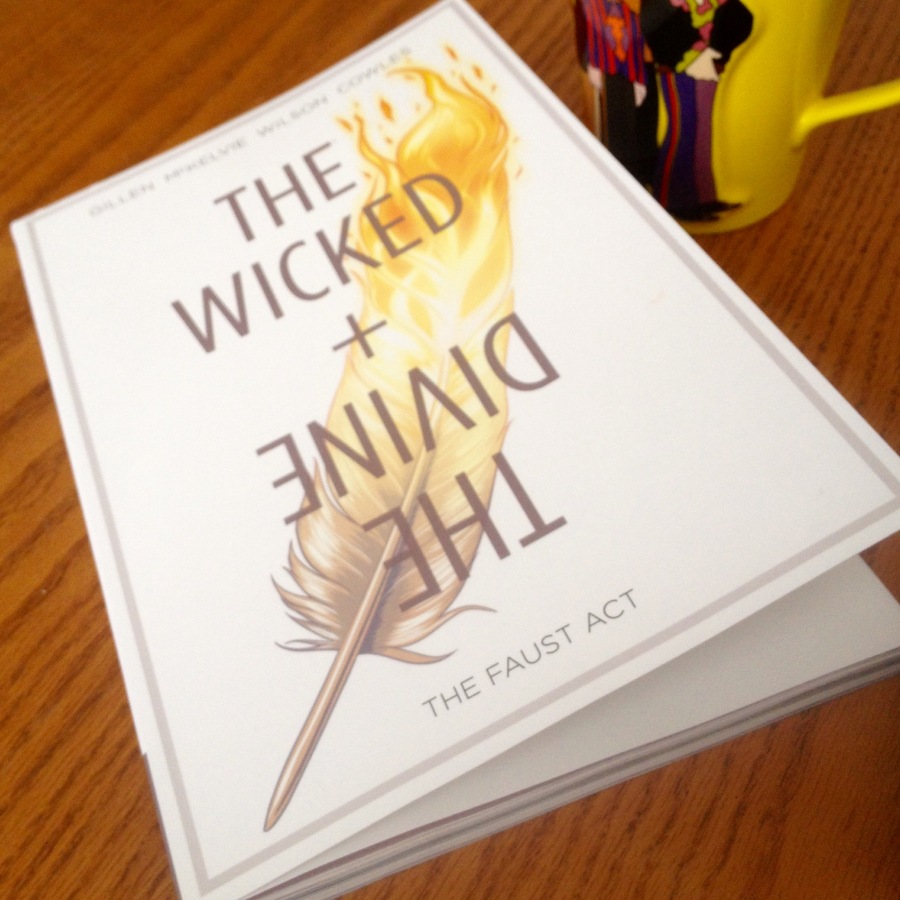
…And I’ve attempted to avoid all of them. I obviously enjoyed Kieron Gillen and Jamie McKelvie’s The Wicked and the Divine enough to read the issues again, this time as a collected trade paperback titled The Faust Act. I’ve been following the series since I started buying comics again, roughly a year ago, and I’ve enjoyed the pair’s original work, following them from Phonogram and so forth.


But this review is about The Wicked and the Divine. The premise is this: a pantheon of gods return to the earth every ninety years as pop stars. They live for two years, and then through various means, pass away from this world. For the current recurrence, we readers have Laura, a uni student and admitted fangirl, to serve as our eyes and ears and entry into the world of the gods. Laura strikes up a relationship (flirtation/quasi-employment) with the incarnation of Lucifer, brilliantly inspired by David Bowie. This leads to all kinds of mayhem, and Laura’s further inculcation into the pantheon.

The gods themselves are portrayed as human and petty as such gods as ever have been, yet they continue to hold some fascination for the faithful. In this first trade, we get glimpses of their world: assassins, conspiracies, mind-boggling powers.Those powers themselves are fairly shadowy. Even within their world, only those who attend the shows are able to experience the gods’ power, as any attempts to record the music result in only static and silence. As for the shows themselves, imagine the best concert you’ve ever been to, and then imagine you experienced religious levels of euphoria, possibly resulting in passing out or sexual climax (or maybe both?).

My favorite character is Laura. I can’t relate to any of the gods, but she is unapologetic in her fervor for the gods. She is quintessentially a fan, in a universe where fan tips over into zealot. One of my favorite bits is Laura’s inner commentary on the proceedings, the things she says to herself (and to us) that she believes are too much for everyone else to handle. Everyone can relate to that. I don’t dig her desire to be one of the pantheon, that thirst to be special, but even that is something everyone can see in themselves.

The art is beautiful. I always admire McKelvie’s line work, but Matthew Wilson’s coloring is radiant, reinforcing the idea of candles burning too brightly. As to the story, as I read the trade, I was confused by several points, such as the gods’ purpose (Ananke makes a brief reference to inspiration, but otherwise the point is not driven home). But this is at heart, a long, high-concept murder mystery (lasting roughly two years). I’ll be re-reading the second trade as well, and I expect those issues will be clarified.

wicdivsnap.jpg

This review has been cross-posted to the Cannonball Read. My goal is to read 52 books in 2016.